
Our Research
Bacterial population genomics and metabolism
Bacteria are highly diverse organisms. Even within a single species there can be substantial diversity in terms of lineages (or ‘clones’, groups of closely related strains) and gene content. Bacterial population genomics is the study of patterns in genetic variations, and its association with evolutionary history, ecology and clinical risks. This information is key to detecting and tracking emerging health threats through genomic surveillance, and to inform the design of novel therapeutics and vaccines.
We explore the population genomics of high priority bacterial pathogens, primarily those that cause infections in hospital settings, with high rates of resistance to antibiotics. Much of our work has focussed on Klebsiella pneumoniae, the World Health Organization’s #1 priority drug resistant pathogen associated with ~750,000 annual deaths globally.
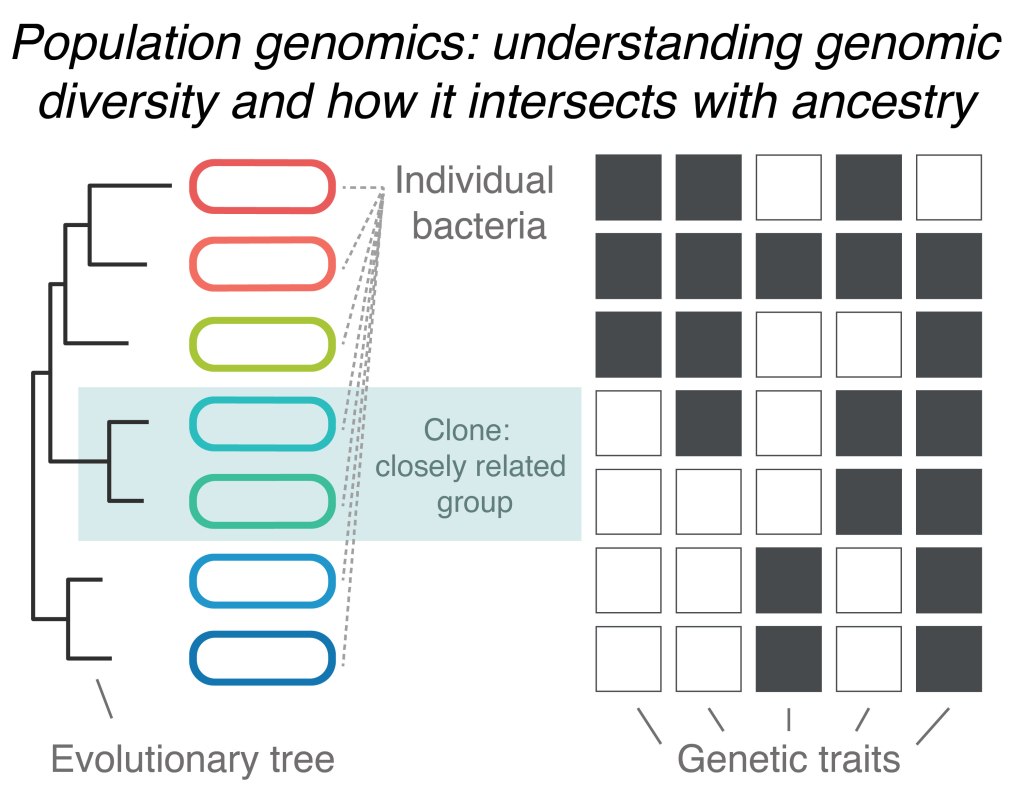
Our projects include:
- Developing a clone-specific genomic risk framework to systematically identify clinically-relevant clones and the frequencies with which they carry known antimicrobial resistance and virulence genes, and other key traits.
- Identifying novel traits associated with specific clinical risks e.g. multi-drug resistance, hospital transmission.
Over the past few years we have been working to develop new approaches that are allowing us to expand into a new domain that we call population metabolism– i.e. understanding bacterial metabolic diversity in the context of the population genomics framework. We have implemented Bactabolize– a high-throughput pipeline for generating strain-specific genome-scale metabolic models and predicting growth phenotypes at scale. We have also generated a highly curated and validated pan-reference metabolic model for K. pneumoniae, encapsulating the metabolism of >500 strains. Together these resources allow us to generate draft strain-specific models for thousands of strains and predict thousands of growth predictions for each. Using this approach we recently showed that there is substantial metabolic diversity among K. pneumoniae and that this is highly structured across the population such that each clone has its own core metabolic profile. We showed that this diversity allows strains from different clones to ‘cross-feed’ in laboratory culture, and propose that metabolic variation facilitates the long-term persistence of diverse clones in natural populations. We are continuing to apply our comparative metabolic modelling approach to identify metabolic traits associated with clinical risks and to understand the interplay between population structure, metabolism and ecology.
Genomic typing of surface polysaccharide antigens
Many bacteria produce protective sugary molecules on their surfaces, such as capsules and lipopolysaccharides, that are recognised by the human immune system and provide binding sites for bacteriophage (viruses that infect bacteria). These molecules are priority targets for vaccines and novel therapeutic strategies, but the polysaccharide structures can vary substantially between strains, and for many species there is no scalable or accessible phenotyping approach with which to prioritise variants as vaccine or therapeutic targets.
We developed Kaptive, a tool for the prediction of capsule and lipopolysaccharide variants from genome data, which allows us to leverage large-scale whole genome sequencing projects to explore capsule and lipopolysaccharide epidemiology. Kaptive was originally implemented for K. pneumoniae and its close relatives in the K. pneumoniae Species Complex, and was later expanded with databases for Acinetobacter baumannii, developed in collaboration with Assoc/Prof Johanna Kenyon (Griffith University). We are continuing to develop new databases, and to improve the functionality and accuracy of Kaptive. We are working with global partners to apply Kaptive to genome collections to predict capsule and lipopolysaccharide frequencies. We recently co-led a mammoth collaborative project to estimate the capsule and lipopolysaccharide frequency distributions among Klebsiella causing neonatal sepsis in low- and middle- income countries, where K. pneumoniae causes the major burden of these infections. We are also working with collaborators in academia and industry to generate new capsule phenotype data and develop new approaches for predicting phenotypes from genome sequences.
Supporting global genomic surveillance

We believe that our work isn’t finished unless the knowledge and tools we generate are accessible to the broader research and public health communities. We are contributors to the KlebNET Genomic Surveillance Platform (KlebNET-GSP) – a collaborative project with the aim to harmonise analysis tools and databases that support genomic surveillance of Klebsiella and E. coli. KlebNET-GSP brings together the developers of the K. pneumoniae BIGSdb, Pathogen.watch global pathogen surveillance platform, Kleborate and Kaptive. It also aims to develop training resources, promote and facilitate a lively community of researchers and public health professionals working on Klebsiella genomic epidemiology and surveillance. As part of this project we are coordinating a community curation effort to generate an open source repository of contextual metadata for K. pneumoniae genomes, with the aim to maximise the use and reuse of this rich data source by the global community.
Collaborators
We are extremely grateful to be able to work with talented and knowledgeable researchers from across the globe. There are too many to name everyone here, but we would particularly like to acknowledge:
- Dr Margaret Lam – Monash University, Australia
- Dr Jane Hawkey – Monash University, Australia
- Dr Francesca Short – Monash University, Australia
- Dr Adam Jenney – Alfred Health, Australia
- Prof Kathryn Holt – London School of Hygiene and Tropical Medicine, UK
- Prof Sylvain Brisse – Institut Pasteur, France
- Dr Jonathan Monk – University of California San Diego, USA
- Assoc Prof Johanna Kenyon – Griffith University
- Dr Iren Löhr – Stavanger University Hospital, Norway
We are always happy to discuss new collaborative opportunities. If you have a project you would like to discuss, please contact us.
Funders
We thank the following organisations for supporting our research:
Current
- Australian Research Council
- Gates Foundation
- Monash University
Past
- National Health and Medical Research Council, Australia
- Australian Society for Antimicrobials
- University of Melbourne
 Wyres lab